
 Personal branding expert and networking guru Wendy Terwelp wants job seekers to think about and improve their brand messages. According to Wendy, “Job seekers already have a brand, whether they know it or not. What do people think about them? Are they known for a great sense of humor, or maybe for being a savvy networker?” Wendy says that job seekers can edge out their competition by defining and communicating a consistent brand message throughout the job search.What are you known for in your industry, and how can you improve your brand message? Wendy offers a Personal Branding Quiz so you can assess your brand message’s status. Click here to take the quiz.Best wishes,Kim Isaacs
Build Your Brand with Wendy Terwelp
Job Search Spam: How Do You Handle It?
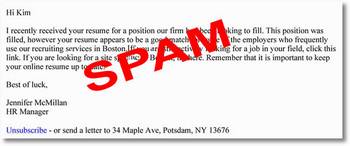 Today I received this email with “your resume” in the subject line:Hi KimI recently received your resume for a position our firm had been looking to fill. This position was filled, however your resume appears to be a good match for some of the employers who frequently use our recruiting services in Boston. If you are still actively looking for a job in your field, click this link. If you are looking for a site specific to Boston, try here. Remember that it is important to keep your online resume up to date.Best of luck,Jennifer McMillanHR ManagerI haven’t applied for a position since the early 1990s, so the email is either spam or we’re looking at some pretty slow follow up. Okay, it is obviously spam. However, if I were in an active job search, an email that appeared to come from a hiring manager would surely catch my attention.Ms. McMillan’s email was deceptive because she was alluding to a resume that I submitted; an unsuspecting job seeker might think it was actual resume follow-up. Job seekers are bombarded with spam all the time – career firms offering a “free resume review” (of course they will find problems and offer to fix for a fee), multi-level marketing plans, get-rich-quick schemes, fraudulent emails pretending to originate from reputable sites, and scammers advertising job opportunities but who are trying to get money or steal the job seeker’s identity.What can you do to protect yourself and avoid wasting time with spam, while still being open to real job opportunities and services that can help your job search? A good starting point is Monster’s primer on preventing email fraud: Tips for a Safer Job Search.I recommend setting up a disposable email address specifically for job search activity so you can easily say goodbye to the spam when you land a new position. When reviewing emails, always use common sense and don’t be afraid to investigate companies that raise red flags — if it sounds too good to be true, it probably is.How do you deal with job search spam? Please feel free to share any tips that have worked for you.Best wishes,Kim Isaacs
Cover Letter Tip: Customize Your Letter
 We received an inquiry from a desperate job seeker who didn’t know why her resume wasn’t working. I reviewed her resume and it looked quite good, so I asked her to forward a copy of her cover letter. She forwarded it to me from her Sent folder, so I saw how she was sending it to employers. The first line said, “In the interest of applying for your <insert job title here> position, I am sending my resume for your review.”Yes, she was sending her cover letter without customizing the “placeholders.” What would the hiring manager’s first impression be? Most likely, that she doesn’t care enough about the opportunity to tailor her cover letter and she’s probably sending the same letter all over town.Employers like to feel special. Give them the royal treatment in your cover letter. You can take less than 15 minutes to customize your letter, address the employer’s specific needs, and present a value proposition that will make the hiring manager want to call you right away. At the very least, if you’re using a cover letter template, remember to fill in the placeholders with the correct information.Best wishes,Kim Isaacs
Resume Writing Tip: Don’t Copy Resume Samples Verbatim
 People love to see samples, especially resume samples. A quick search for resume sample books on Amazon.com returns nearly 1,000 titles. Search Google for “resume sample” and you’ll see nearly a quarter of a million results. A well-written resume sample in your field can provide guidance and inspiration, but be sure not to copy the content word-for-word. If you do, you could end up with a resume that doesn’t adequately represent you or one that employers have seen before. You won’t be making a good first impression if an employer recognizes your resume from an online or book sample.I see popular online samples regurgitated quite often — a resume arrives in my inbox for review, and it sounds good until I realize that I wrote it, or one of my writers or colleagues wrote it. Resume writer Teena Rose (author of cover letter sample book Designing a Cover Letter to ‘WOW’ Hiring Personnel) said it best, “Use the samples as a guide for ideas, but take pride in writing a resume that has your own unique content and visual appeal.” Well said, Teena!Best wishes,Kim Isaacs
Second Life Job Fair – May 15-17
 Check out TMP Worldwide’s upcoming job fair to be held in Second Life, May 15-17 on TMP Island. If you don’t have a Second Life account, you can sign up here. The job fair will be the first virtual job fair of its kind, but some of the traditional rules of job fairs still apply. Before the event, research companies to learn about their mission and goals and figure out why you would be an asset to the organization (here’s a list of company participants). Be prepared with “speeches” — know what you plan to say to (or type to) hiring managers, including your value proposition and questions that you plan to ask. Follow up in real life with hiring managers with whom you interacted.If you attend, please drop me a note to let me know about your experience, and good luck!Kim IsaacsPhoto courtesy of Josh Bancroft via Flickr. Licensed under Creative Commons. Thanks, Josh!
Resume Writing Tip: Have You Done Community Service?
 I’m a big fan of including volunteer work on the resume to show leadership skills and commitment to important causes. However, be careful how you word your volunteer section header. One of my colleagues, Sally McIntosh, advises against using the term “Community Service” — this could give the impression that you received a court-mandated sentence to do community service after committing a crime. Alternative titles for your volunteer section include Volunteer Work, Community Involvement, and Civic Activities.Best wishes,Kim Isaacs
Resume Tips to Escape Your Dead-End Job
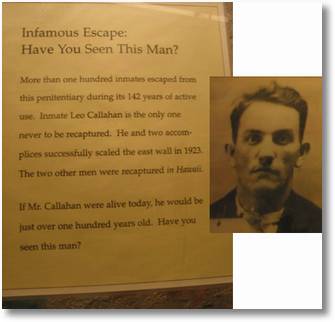 I visited Eastern State Penitentiary in Philadelphia this week, and even though the prison is rich with history and housed some famous inmates (including Al Capone), I was most intrigued by the story of Leo Callahan. Leo and five other inmates escaped from the prison in 1923 by holding up guards and scaling the prison wall (a wall worthy of Spider-Man!). His buddies were later caught, and more than 100 other inmates attempted to escape during the prison’s 142 years of operation. Leo was the only one who was never recaptured.Do you feel trapped like Leo did, only you are trapped in a dead-end job? Are you eager to taste freedom? Are you willing to take the time to plan your escape, using the resources at your disposal to permanently break from your current employer? Like Leo, you need to put in your time for now, but create and implement a foolproof plan of action that will ensure your successful escape. Of course, your escape won’t involve criminal behavior and a search team, but if you’re lucky you might get a nice good-bye party and a chance to enjoy going to work each day.The first step is to figure out what kind of career, job, and employment situation would make you happiest. This could be the hardest step because it requires a significant amount of introspection. Career books are a good starting point, and one that I like is I Could Do Anything If I Only Knew What It Was: How to Discover What You Really Want and How to Get It by career counselor Barbara Sher. A visit to the library or local bookstore should yield books that would work for you, and I recommend that you pick up a bunch of books and dig in. If you are making a career change as well as a job change, you will need to do industry-specific research to learn about your new career. It’s also a good idea to talk to people in the industry — consider asking for informational interviews to glean insider information that will help you make informed decisions about your career transition.This post is about resume tips to escape your dead-end job, so why so much talk about pinpointing your career goal? Because you can’t create a dynamic resume if your job target is fuzzy. When you’re clear about your career goal (or goals), it’s time to tackle your resume. Follow these tips to create a resume that will work hard for you:1. Target a specific goal: I frequently talk about the importance of creating a targeted resume, and this is key to creating a resume that will get noticed. It’s not a good idea to let hiring managers guess your career goal. Use a tagline and Qualifications Summary to highlight your objective and important qualifications.2. Define your brand: What differentiates you from the other job seekers in the candidate pool? What if an employer receives 1,000 resumes — how will you stand out? That’s where your brand message comes in. You need to figure out why you are more desirable than your peers, and then make sure that every word on your resume supports your brand message.3. Highlight accomplishments: If your resume outlines how you went above and beyond your daily duties to really contribute to your employers’ operations, employers will be interested in talking to you and seeing how you would do the same for them. Be sure the focus of your employment history is on accomplishments, not basic job duties.4. Show passion: One of the problems with being stuck in a dead-end job is the lack of passion that it induces. Don’t let that translate to your resume. If you’re emotionally detached from your job, you might inadvertently use dull, lifeless language to describe your position. I recommend putting a positive spin on your job, and focus on the tasks and accomplishments that you do enjoy. For example, if you’re in accounting and crunching numbers makes you pull your hair out, don’t focus on the numbers aspect of your job. Instead, think about special projects or other assignments that are related to your goal and highlight them. If your resume is focused on the boring tasks that you hate, hiring managers will pick up on those tasks and think you would be perfect to do the same for them. Escape this fate by demonstrating passion for your current career goal.5. Be proactive: Don’t just send your resume out and wait for the phone to ring. Build relationships, network within your industry, and follow up on resume submissions. Keep a log of your job search activities — check out JibberJobber for excellent tracking tools.6. Be innovative: More and more job seekers are getting noticed by using web resumes and social media tools to present their qualifications. You could be left in the dust if you don’t have an online career folio, career-related blog, and profiles on social networking sites such as LinkedIn.com. Resume styles and techniques are constantly changing, so stay on top of cutting-edge strategies so that you’re poised to grab a great opportunity…and escape your dead-end job.Best wishes for a successful job search,Kim Isaacs
Should You Include the Job on Your Resume if You Were Fired?
 Martin writes, “I was fired from my last job, which I held for over six months. The HR director would probably say I was fired if employers were checking my history. Should I just omit the job from my resume? This is my second job out of college.”Kim’s Answer: I’m sorry for your recent job circumstances, and I hope that your next position is a great opportunity for you. I wouldn’t omit your last job because it’s possible that they would say you were fired. Be ready to explain what happened in an interview, keeping the explanation as positive as possible. Check out Ryck’s post at the Monster Blog on how to explain getting fired.If this is only your second job, keep in mind that it’s common for people in their early career to switch jobs. Some employers like to source candidates with several years of work experience because they’re more likely to know what would be a good fit. It will be important for you to do a lot of research on your target job and target employer so that you are more likely to find a position that works for you.Best wishes,Kim Isaacs
Resume Writing Tip: Turn Off Track Changes
 We received a resume services inquiry from a frustrated job seeker who wrote, “I’ve sent my resume out so many times but I never get a call back. I need help!”I opened her resume to see MS Word’s “Track Changes” feature turned on, and someone had written this comment in his work history: “Can you stretch this date a bit more to cover the gap?”Eeeeek! I can’t imagine any employer calling her after seeing that. Please make sure Track Changes is turned off before submitting your resume to an employer. Here are a couple of excellent guides for disabling Track Changes:Microsoft Office Online Help: Get Rid of Track Changes and Comments Once and For AllUSA Today: Remove Hidden Data in Microsoft Word Documents (written by Kim Komando)Best wishes,Kim Isaacs
Free Resume Critique from ResumePower.com: Critique #1
 This is the first installment in a series of free resume critiques that I announced I would be offering last month. I received an overwhelming number of critique requests, so thank you to everyone who submitted. If I don’t get to you, I hope that you benefit from the feedback given to others as well as by the information on this blog and the ResumePower.com website.Resume writing is subjective and is an art as much as a science, so you might have different recommendations for the job seeker. Feel free to post your feedback in the Comments section — all opinions are welcome!Click here or the following thumbnail image to view the resume submitted for a free critique (PDF format), and then read the review:
 Resume CritiqueThank you for sharing your resume for a free critique! Your restaurant management background and career progression are very impressive, and I see a number of ways that you can enhance your presentation. Please review the report for specific recommendations. Best wishes for a successful job search!All the best,Kim IsaacsDirector, Advanced Career Systems, Inc.www.resumepower.comContent Recommendations:1. Add a title or headline to your resume. This goes directly below your name and contact information, and gives you a way to quickly communicate your restaurant management career goal. In your case, try something like, “Experienced Restaurant, Hospitality, and F&B Manager.”2. Add a Qualifications Summary . The summary goes below the title, and can be written as a few bulleted statements or as a brief paragraph. This is an opportunity to present your “value proposition” — sum up the key strengths you bring to the table and why they should hire you. Here’s an example:“Accomplished leader of full-service restaurants, high-volume operations, and top-performing teams, with nearly ten years of restaurant and F&B management experience. Proven success driving historic gains to revenues, margins, food quality, customer satisfaction, and number of daily covers served. Expert in improving food/labor cost controls, customer service, and efficiency of front- and back-of-house operations. Accustomed to high levels of responsibility (have managed $1.8M operations and teams of up to 30 personnel), and backed by ServSafe certification.”3. Add a “Key Skills” section between your profile and “Experience” sections. Most commonly written as a bulleted list in a two- or three-column format, this section instantly communicates your areas of expertise and helps to maximize keyword density in your resume. Keywords are industry-specific terms, jargon, acronyms, or “buzzwords,” including job functions, specialized skills, and computer applications. Many employers scan and store resumes, and job boards like Monster are searched by employers to find qualified applicants. The more keywords your resume contains, the higher to the top of the pile it will rise. Here are a few examples of keywords that you might want to include in your “Key Skills” section (of course, only use the keywords that match your expertise ):
- Restaurant Management
- Labor/Food Cost Controls
- Safety/Quality Controls
- Multi-Outlet Operations
- F&B Operations
- Guest Relations
- Menu Development
- Vendor/Supplier Negotiations
- Kitchen & Dining Room Layout
- Teambuilding & Supervision
- Budgeting/P&L Management
4. Strengthen your “Experience” section by including accomplishments . Your resume is heavily focused on your responsibilities, but it would be much more effective if you also include examples of how you have gone “above and beyond” in carrying out these responsibilities. Employers want to know not only what you have done, but also how well you have performed. The best way to achieve this is to follow the brief description of your responsibilities with a few bulleted examples of results, outcomes, and benefits you have delivered. For example, if you lowered costs to an all-time low while simultaneously elevating food quality and customer satisfaction, this is definitely something you should communicate in your resume.Other examples of accomplishments might include ways that you have improved employee retention/morale, increased safety/sanitation scores during inspections, enhanced amenities and value-added guest services, negotiated discounts on inventory/supplies, reduced overtime, implemented improved inventory security, or surpassed sales projections in dining room or banquet operations. Wherever possible, try to quantify your accomplishments with numbers, percentages, dollar amounts, or before/after comparisons to add credibility to your claims. Here are a few examples of quantified accomplishment statements:
- Cut costly overtime in half, increased labor efficiencies by 8.8%, and lowered food and beverage costs to a combined 31% to deliver record-high profits of $626K in 2006.
- Tripled banquet/catering sales to reach an all-time high of $780K despite a major increase in local area competition.
- Led a complete overhaul of restaurant, organizing all areas and repairing or replacing faulty equipment. Efforts catapulted inspection scores from an average of 78% to consistent marks of 96% or higher.
Design Recommendations:1. Be consistent in your headings. For example, you use all capital letters for your “EDUCATION & CERTIFICATIONS” section, but you use both upper and lowercase letters for your “Experience” section.2. Be consistent in your formatting. For example, a horizontal line appears below your “Experience” heading, but in your “Education & Certifications” section, the horizontal line appears above the heading. Your most recent job is formatted using full justification, and the rest of your positions are left justified.3. Lengthen your resume . A manager with your level of experience needs a two-page resume to adequately showcase a history of career accomplishments.4. Add space between each of the jobs you have held. This makes your document more reader-friendly by avoiding a “cluttered” look.Language Mechanics Recommendations:1. Proofread your resume . You have errors in spelling, capitalization, and punctuation, and your resume should be 100% error-free. For example, the abbreviation “f&b” should be capitalized (“F&B”), “work sight” should be changed to “work site,” and “end of the day paper work” should be written as “end-of-the-day paperwork.”2. Eliminate personal pronouns throughout your resume. It is assumed that you are writing about yourself, so you can use an “implied” first-person voice without using personal pronouns like “I,” “my,” or “me.” Replace personal pronouns with short action statements. So, instead of writing, “I did setup for morning coffee service…,” try, “Handled setup for morning coffee service…”